

My start in software was early. By my junior year of high school I was already developing software professionally. When others were finishing their second year of college, I was the CTO of a small software company. I wrote most of the software for a company we’d grow to about $10m in annual sales, had 2 other developers working for me, and also managed a 5 person QA/Support team.
With that in mind, I have a reaction to seeing so many job postings in the software industry that look like this:
Bachelors degree or equivalent experience
10+ years of experience building software
The first line is the requirement. The second line is a fig leaf — a way of technically not lying while still signaling what the process actually rewards. It was always a questionable practice, but AI is supercharging the impacts of this mistake.
The Logical Problem
Let’s start with the plain English issue, which is almost embarrassing once you see it.
From a logical point of view, these statements are redundant. 10+ years of experience will always be equivalent experience. There is no interpretation under which a decade of real-world engineering doesn’t constitute equivalent experience to a four-year degree.
The problem runs deeper than embarrassing logic. The reality is that equivalence is probably fiction. Most hiring managers, I’d wager, didn’t author this language and don’t think about it. But it activates biases in recruitment teams, offering a lazy shortcut, and sending the wrong message.
Automation and AI are Supercharging this Mistake
This was always a mistake, but it’s becoming more critical. Recruitment teams scanning resumes will be drawn toward an education section more readily than to calculating the equivalent experience. Automated tools in applicant tracking systems (ATS), including AI, have the same weakness, often more so.
How is a typical large language model (LLM) going to process these statements? The degree is a binary, well-defined data point with a clear answer. “Equivalent experience” is the opposite: fuzzy, context-dependent, requiring judgment. Even if the LLM evaluates the two statements correctly, it could make another mistake, treating the “or” as an “and”, or treating the two statements as components of an overall “closest match”.
These mistakes could cause a filter to fail, or it could cause a lower score. If the three clauses are processed independently, the degree holder gets 3 points, other candidates 2. If qualifications aren’t scored equally, one earlier in the list will usually get more weight. Even if a system doesn’t intentionally add a scoring system, a reasoning model could create one on its own.
More advanced systems are less likely to make these mistakes, but recruitment teams may not use the most advanced systems. This might be motivated by cost, or adoption started before systems advanced. They may even be non-AI, simple text analysis.
In this environment where job postings get hundreds of applicants, because every applicant is applying for hundreds of positions, a naive filter or scoring system can have a dramatic impact. The more nuanced aspects of a resume that should make you a top candidate, may never get processed. That means fewer interviews, dramatically reducing the probability of a successful interview.
What should you do?
The simplest thing to do is remove any such text from job descriptions. Since they are duplicative, and creating unintended effects, just delete them. And it’s not just those “or equivalents”. You should rethink degree requirements in general.
That’s not enough though.
Our analysis makes clear that successful adoption of Skills-Based Hiring involves more than simply stripping language from job postings. To hire for skills, firms will need to implement robust and intentional changes in their hiring practices – and change is hard. Still, despite the limited progress to-date, our analysis shows that, for those who embrace it, skills-based hiring goes beyond corporate virtue signaling. It yields tangible, measurable value. Skills-Based Hiring boosts retention among non-degreed workers hired into roles that formerly asked for degrees. At Skills-Based Hiring Leader firms, non-degreed workers have a retention rate 10 percentage points higher than their degree-holder colleagues. Workers benefit as well. Non-degreed workers hired into roles that previously required degrees experience a 25 percent salary increase on average.
If you’re not deliberate about this when working with your recruitment team, you may get no change or the wrong change. If they remove “or equivalent experience”, keep an internal filter or priority ranking, or just act on their own biases, you may get no change at all.
Should that be your intent? You might ask if you’re better off with the filter. There’s a couple things you can do to validate that this isn’t sensible. First, you might want to familiarize yourself with the actual rates of postings and workers. In many cases, the postings are more restrictive than the workers. Something seems wrong if it is true that if you had to rehire the entire workforce, 20% would be excluded. If 66% of those without a degree already doing the job wouldn’t get a job, you have to wonder.
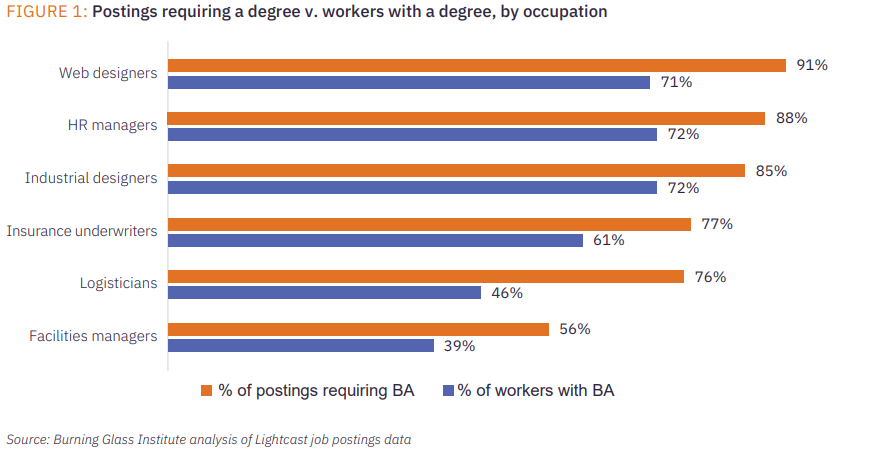
Is that not enough? Then ask yourself, do you know something about the other 20% that makes you want to exclude them? I suspect you don’t. Once on a job, no one asks, but most assume.
Here’s the test: which of these has happened for you more often when working with professionals in their field?
You learn someone doesn’t have a degree, and say, hmm, would have never guessed that! Bob is so smart.
You learn someone doesn’t have a degree, and say, oh, now that explains it, I always wondered why Bob was so dumb.
It’s possible you have little data to work with, because people working on solving a hard problem don’t ask that kind of question. It does come up socially on occasion. If you do have a data gap, it’s not hard to close, just ask a few people. You’ll have to ask 50 people if they have a degree to find 10 that don’t. Because both the affirmative (no degree = smarter), and null hypothesis (no predictive power from degree), are on the same side, it doesn’t take a large same size to disprove the implied assumption.
The strongest case to put a degree on a qualification list is early in careers. This is where “or equivalent experience” actually makes sense. A candidate who just spent four years studying, 2 of it on practical development work is reasonably comparable to one who spent 4 years building products
But AI is hurting college grads. Should we give them an advantage?
There’s a pair of stories circulating about how bad recent grads have it in the job market. Should we give them an advantage, ensuring their expensive degree doesn’t come without rewards? There’s two data points cited on this topic, unemployment and underemployment. Both have flaws in their representation.
Underemployment
The underemployment data point is weakest, and generally just demonstrates a blind spot for those circulating it. The recent number is 41.5%, which does sound horrible without context. But all data should have context. This is not news, it’s a failure to understand the data. If I heard a number like that, I’d ask.. Well what is underemployment.. And what was it like in the past? It’s not hard to find the original source.
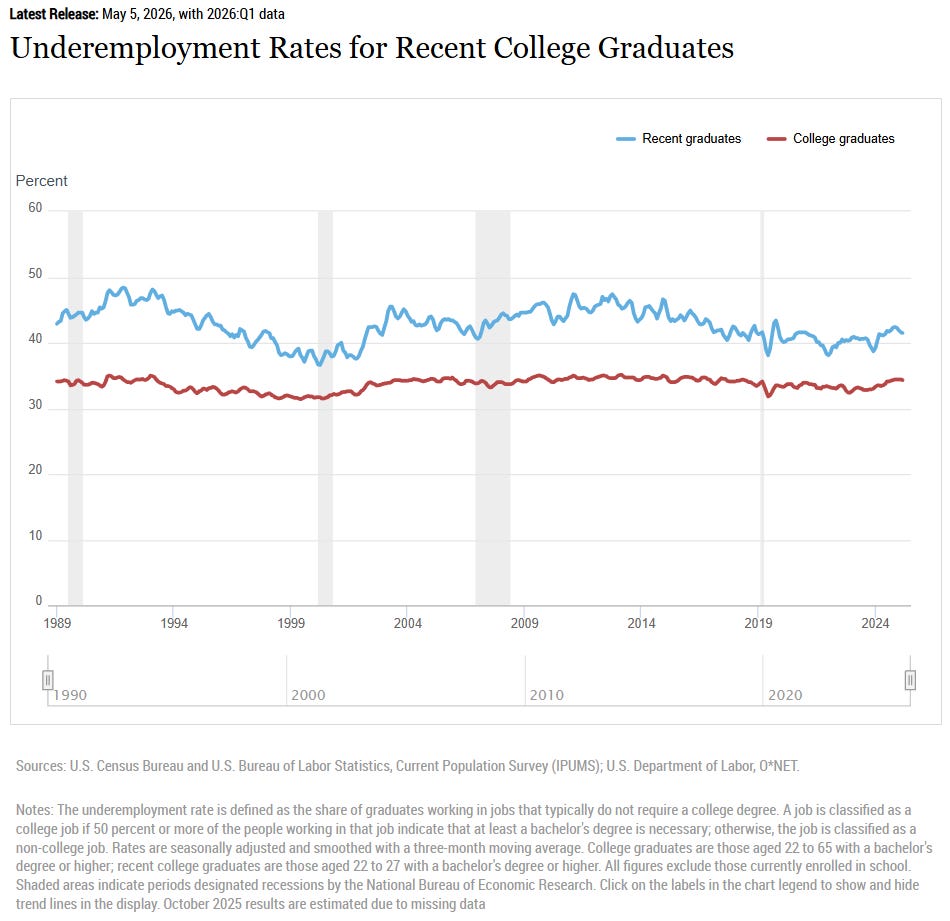
What you can see below is that 41.5% is lower than most historical periods. Is that worth freaking out over? No.
If you read the explanation, you understand why the number is this high. It asks people, working in the job, if a college degree is necessary. If you polled me about any software engineering, I’d answer no. I’m sure it is on the list, because probably the majority of the 80% of software engineers who do have a degree are answering yes.
While software engineering is likely on the list1 I can think of a lot of other things people commonly go to college for that even the college grads would likely answer no. Went to school to study art or music? Would you classify that as requiring a degree? Filmmaking? Social worker? What about some that might be on the list but are debatable? Journalist? Newswriter?
There’s also some majors on this list that appear because it’s tracking recent bachelor grads, but these majors usually go on to higher degrees (JD), law, business (MBA).
Unemployment
The unemployment story is more nuanced, but still represented as more than it is. It does show a change, but is it worth the reaction it has received?
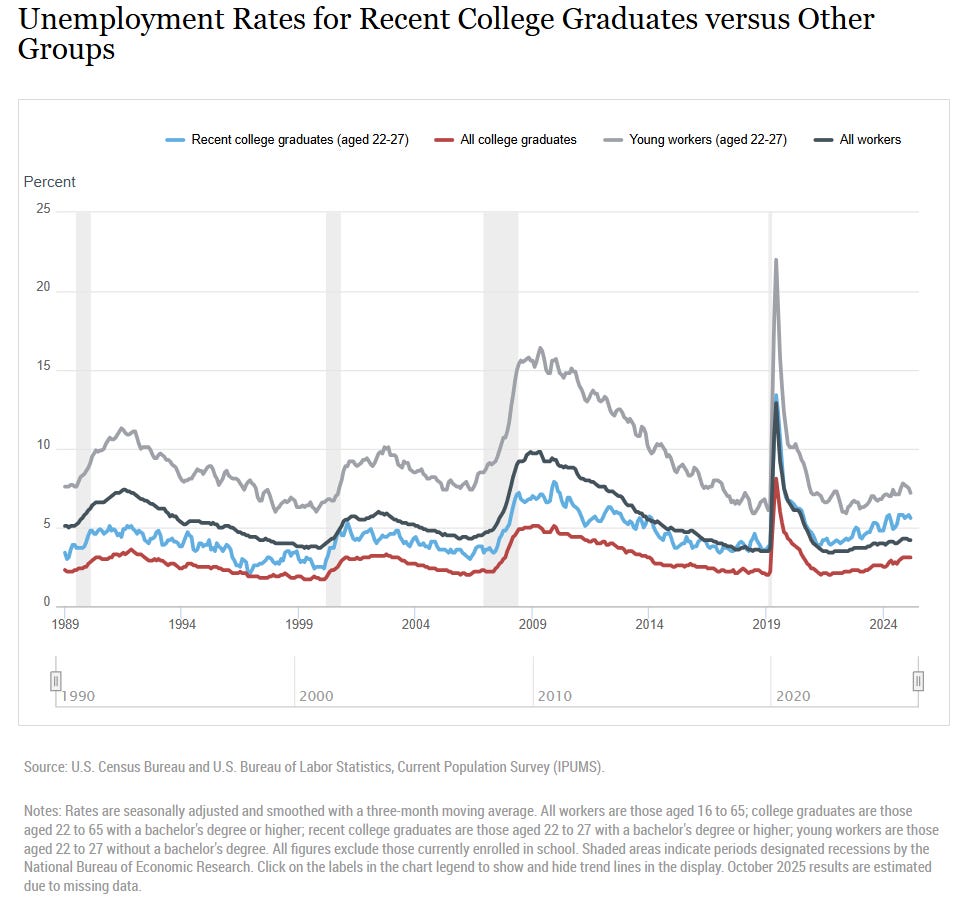
What news stories highlight is that the light blue line (recent college graduates), has never been above (all workers) in the past. But is this a fair comparison? After all, a recent college graduate by definition starts unemployed. At some point in that 5 year span, they graduated, and started job seeking. It’s an apples to oranges comparison. All workers are the incumbents. Some of those workers may have been working the same job for the last 10 or 20 years. Since unemployment rates are based upon those “seeking” jobs, what you’re comparing here is first a fraction of all workers who lost a job recently, and then a sub-fraction of those who had difficulty finding a new job, vs. all college graduates, a fraction of which had difficulty finding their first job.
Shouldn’t “recent college graduates” be compared against “young workers”? There’s still a story there, in that the gap has shrunk, but the story isn’t that college graduates are getting a raw deal, but that there’s more equity between with/without. That’s a lot harder to make a decision about. How big a gap do we expect here? Don’t we want employment opportunities for those without a degree?
The Blind Spot
Partly I’m calling this out because it’s a current story that people are getting wrong, but partly I’m also demonstrating a general blindness that seems pervasive in what I’ll assume are mostly college grads discussing this story. They assume that the worlds of college grads and non-college grads are so universally distinct that there would be no overlap here. They assume that the only way you could be prepared for a job fit for a college grad is the same path.
The reality is that in terms of learning, college is just a convenient path, with a lot of resources laid out in front of you, no other responsibilities, and encouragement to follow a plan. College is many other things, a credentialing mechanism and an opportunity to build social networks, for example. But in terms of learning it’s not magical. You learn by consuming information and solving problems related to what you’re learning, and that opportunity has a lot of entry points.
Conclusion
College should be valuable to those that go. But its value should always stem from the learning it enables. Learning comes from many sources, the college experience is simply a well-resourced and well-structured source. Job experience is valuable in its unique way. In both cases, you have to make those experiences count. Your curiosity, your interest, and your hard work are what translate experiences to learning. A college experience, when done well, should be able to do this more effectively than a job. This is because enabling learning is its primary objective, whereas job experience has to compete with other objectives.
All that said, laziness will make any experience intellectually unrewarding. It’s worrying the degree of laziness applied to the hiring process and the data behind recent news stories. We should do better. We shouldn’t blame this on AI, that would be lazy too. Lazy slop was a problem before AI. It has a deeper cause. Maybe it’s growing, or maybe it’s always been with us. Whatever the case, honesty will get us farther than scapegoats.
Barriers, like degree requirements, enacted out of laziness or to create a condition of privilege are a mistake. We shouldn’t use them. In my opinion, degrees shouldn’t matter if you’ve already successfully done the job. This is doubly true if the job is more complex than anything schooling would have covered. In theory, it seems many employers agree, as the terminology, “or equivalent experience” has been common. But words are one thing, practice is another. A lazy translation of intent to practice that fails to meet the goal is harmful. This is but one of many, but hopefully I’ve made it clear how this one is a mistake.
Sources:
Dismissed by Degrees: How degree inflation is undermining U.S. competitiveness and hurting America’s middle class; Joseph B. Fuller, Manjari Raman; Harvard Business School; 2017.
Underemployment in the Early Careers of College Graduates following the Great Recession; Jaison R. Abel and Richard Deitz; National Bureau of Economic Research; 2018.
Skills-Based Hiring: The Long Road from Pronouncements to Practice; Sigelman, M., Fuller, J., Martin, A.; Burning Glass Institute; (February 2024).
The Labor Market for Recent College Graduates; Federal Reserve Bank of New York; 2026
Related articles
Hiring's Accidental War

It should be obvious that job searches have entered an adversarial phase. Nobody planned it, and AI accelerated it, but in a sense it was always there. What interests me is whether we can escape it, and if so, how. I have some instincts on this, that focus on the need to turn away from unnecessary adversarialism in hiring.
While I wasn’t able to find a current list of what occupations are on this list, the category was created for this 2018 study, Underemployment in the Early Careers of College Graduates following the Great Recession. At that time, the largest category of underemployment was as a “manager or supervisor”, then “office and administrative support”, “sales”. The highest paid underemployment category was “information processing and business support”. In terms of majors, the most likely to be underemployed was criminal justice, performing arts, and leisure and hospitality, which you can find both the 2024 data for (in the outcomes by major at the Fed link) and 2013 data for (in the original report as Table 4.6). Even in fields that look like they’d be AI related, underemployment has not grown. Computer Engineering was 15.8% in 2024, 18.0% in 2013. Computer science was 19.1% in 2024, 26.9% in 2013. The only cases it was higher in 2024? Industrial engineering and nursing.
Your post raises some important questions. There are some other related ones. For example, labor economic research identifies a persistent "certification effect", which is hard to explain. There are significant differences, not just in starting salaries, but in lifetime income, between individuals who have completed all but one course toward a degree and individuals who have finished the same degree. This kind of evidence calls into question the idea that the value of a degree is somehow connected with the requirements for it.