

Beyond Observed AI Exposure
Anthropic’s recent labor market analysis has improved understanding by analyzing “observed exposure”—shifting from theoretical feasibility to measuring how AI is actually being used across different occupations. This is a crucial step in understanding AI’s real-world footprint. However, a core assumption remains: if a task can be done twice as fast by AI, the required human labor spent on that task will decrease.
I suggest a deeper framework that confronts that assumption. A significant reason why AI capabilities will not translate into reduced working hours is that observed exposure fails to account for the dynamics of economic demand for tasks. Demand for tasks is not static. As a task progresses from theoretical capability, to observed exposure, to full exposure, dynamic responses should be expected.
The impact of AI does not depend solely on whether a machine can and is used effectively to do work, but on whether the demand for that work is Bounded, Unbounded, or Adversarial. How work is divided between those categories, how it’s packaged into jobs, and the dynamic interplay are critical to accurately predicting how AI adoption will change demand for work.
While I am only presenting the conceptual framework here, extending this to a quantitative analysis via task classification and applying it to datasets like the Anthropic Economic Index is the logical next step.
Tasks, Jobs, Outcomes, and Demand Dynamics
To understand labor impacts, I must separate the elements of work into tasks, outcomes, and jobs:
Tasks are individual units of work executed to achieve a specific result.
Outcomes are the overarching goals or results that a job seeks to achieve through the execution of tasks.
Jobs are bundles of tasks organized and executed to deliver specific outcomes.
To this, I also add three categories of demand:
Bounded Demand: Demand that has finite usefulness within related outcomes, and does not itself enable demand for new outcomes.
Unbounded Demand: Demand with the potential for self-expansion by enabling demand for new outcomes. When scaled, efficiency completes entirely new outcomes with positive value. (Practically speaking, this does not demand a true lack of boundaries, just incredibly distant ones).
Adversarial Demand: A non-bounded state1 driven by a zero-sum competition. When scaled, efficiency drives volume and complexity within the same adversarial outcome.
These three categories of demand are most readily applied to classify tasks, but we’ll find we also think of jobs in this way based on the type of tasks they hold. We can also see how outcomes are key to this, in differentiating unbounded and adversarial demand—separated by whether scaling them generates new outcomes or inflates existing outcomes.
The Dynamics of Efficiency Reallocation
Jobs tend to have a primary outcome (e.g., producing a car, solving a medical issue, resolving legal disputes). When that overarching outcome is adversarial, the underlying adversarial tasks act as an “efficiency sink.”
When AI automates routine, bounded tasks within that job, the worker does not simply work fewer hours. Instead, the time saved is reallocated into the adversarial tasks to maximize the overarching outcome. This dynamic maintains stable human labor hours despite high overall observed AI exposure.
Crucially, if all adversarial tasks are fully automated, the efficiency sink effect moves from labor hours to automation (compute/API) costs. But as long as a single adversarial task is left unautomated, it retains a significant portion of the efficiency sink effect, and total labor hours remain mostly unchanged.
Three Part Demand Framework
Occupational tasks can be categorized into three distinct economic demand buckets. Because jobs are organized to achieve specific outcomes, we observe task-level dynamics manifesting at the job level. When AI introduces efficiency gains, each bucket reacts differently:
Bounded (Satiated Demand)
Reallocation Dynamic: There is no new work to reallocate. Faster outcome completion means work is finished earlier. Fewer workers are needed to maintain the same pace. Unless an unbounded or adversarial outcome indirectly generates new work, available jobs attached to these bounded outcomes will decline.
Job Examples: Payroll Clerks, Data Entry Operators, and Technical Writers. Demand for Payroll Clerks is bounded by the number of companies, workers, and efficiency of the payroll process.
Unbounded Utility (The Infinite Backlog)
Reallocation Dynamic: Faster production lowers costs. A backlog of demand reuses freed resources. Cost efficiencies sustain or expand fulfillment of potential demand. Time saved is used to produce more output, higher-quality outputs, or both.
Reallocation Friction: Reallocation is not immediate. The demand backlog can become stuck for organizational, training, research, finance, or any other coordination issue.
Job Examples: Computer Programmers, Scientific Researchers, and Healthcare Professionals. The backlog of desirable software, scientific discoveries, and medical care is never fully satiated.
True Adversarial (Zero-Sum Escalation)
Reallocation Dynamic: Efficiency gains are weaponized to win adversarial outcomes. Time saved is reinvested into performing the task at a higher volume or complexity to maintain an edge over an opponent, scaling effort within the same outcome.
Reallocation Friction: Escalation between parties can take time to emerge, and can be delayed or deferred by agreement, law, or practical obstacles.
Escalation Attrition: Adversarial escalation eventually hits diminishing marginal returns. If AI allows lawyers to draft 10x the claims and counterclaims, they will do so to maintain an advantage. These claims and counterclaims add little or no extra utility to the justice system. If any, it was such fractional quantities that they would not have been pursued outside an adversarial system. Those dynamics don’t mean escalation isn’t subject to its own attrition where the next escalation not only fails to create social value, but fails to yield individual value.
Attrition and Friction: The combination of escalation attrition and friction is another factor in delayed reallocation. The last layers of escalation yield the least individual value, which lowers any incentive to bypass frictions created by time, happenstance, law, agreement, ethical standards, or other factors.
Job Examples: Lawyers (maximizing legal strategy), Salespeople (maximizing competitive wins), Marketers (battling for attention), and Cybersecurity Analysts (offensive vs. defensive escalation).
Note on Transitions: Tasks and jobs can shift categories. Customer Service Representatives are currently Bounded (dealing with a finite number of human interactions). However, if AI agents drop the cost of interacting with customer service to near zero, these outcomes could transition into Adversarial territory. While a customer-obsessed company does not view legitimate customers as adversaries, an open, zero-friction channel inevitably attracts malicious actors, automated fraud rings, and algorithmic social engineering at scale. Companies will be forced to deploy defensive corporate AI to filter this malicious volume, reallocating human CSRs to investigate and manage these complex, escalated algorithmic attacks.
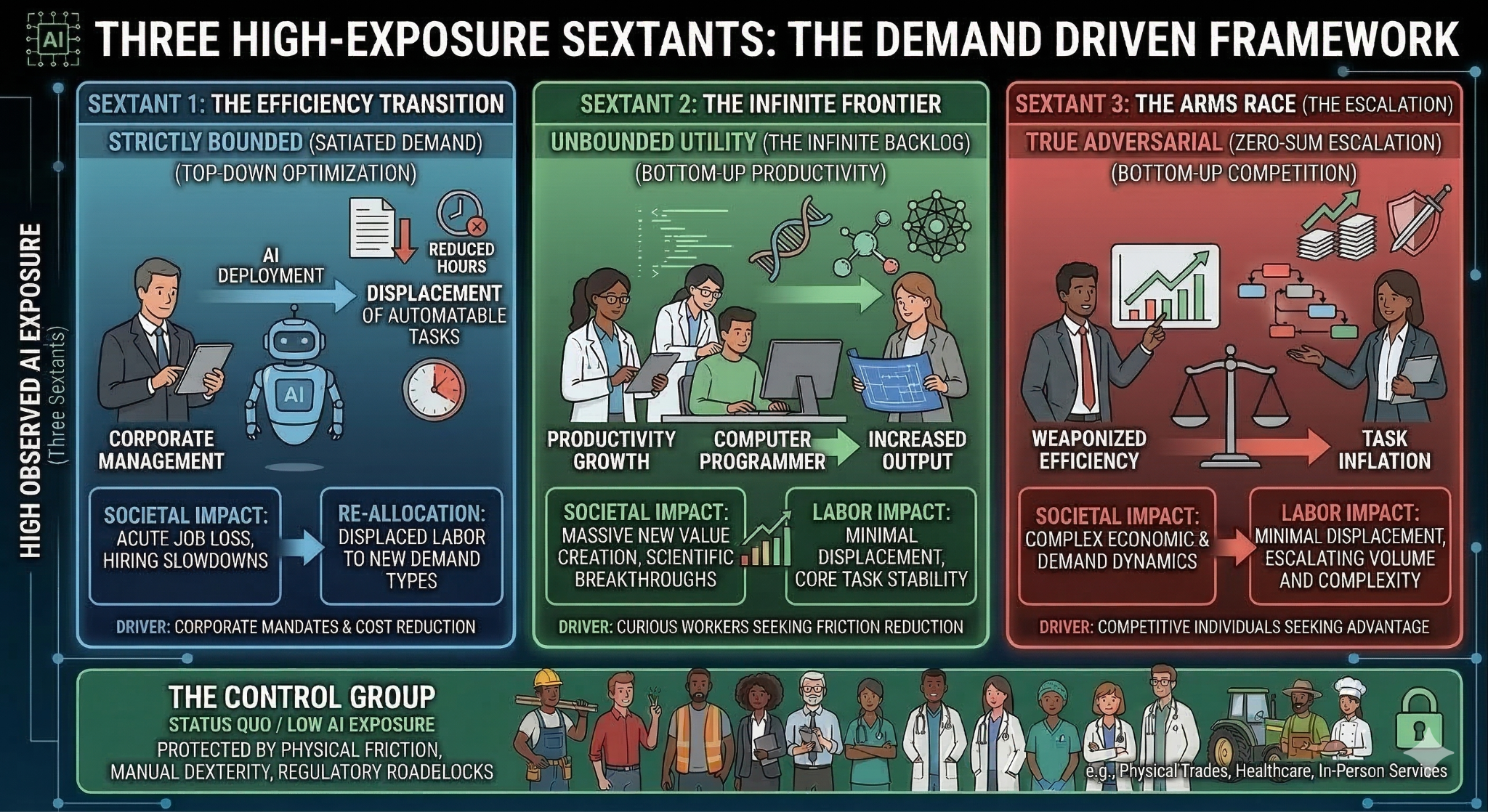
The AI Labor Impact Matrix: “Three Sextants and One Half”
By mapping AI Exposure (High vs. Low) against the 3-Part Demand Framework, I create a 3x2 matrix for describing expected labor market behavior.
The Bottom Half (The Control Group)
Low AI Exposure (across all demand types): Protected by physical friction, manual dexterity requirements, or strict regulatory roadblocks. This represents the status quo (e.g., physical trades, nursing).
The Top Three Sextants (High AI Exposure)
The highly exposed segment of the economy splits into three distinct zones, driven by different adoption incentives:
Sextant 1: The Efficiency Transition (High Exposure + Bounded)
Early Influences: Early adoption is driven top-down by organizations seeking to realize the benefits of automation to reduce labor costs.
Labor Impact: Measurable job displacement and hiring slowdowns. While this creates disruption for current workers, it represents an efficiency gain for the broader economy by freeing human capital from bounded tasks.
Social Impact: Managing this shift requires robust social infrastructure. Social programs like unemployment insurance, retraining initiatives, and general social support must be central to navigating these impacts.
While disruption occurs across all sextants to some degree, societal resources and attention must be most heavily directed toward transitioning workers. Without support you lose both pre-disruption stability and the productive use of freed human capital. There is no social value in structural optimization if it doesn’t lead to new, more productive employment.
Sextant 2: The Infinite Frontier (High Exposure + Unbounded)
Early Influences: Early adoption is driven by closeness to the technology industry.
Labor Impact: Minimal displacement (subject to reallocation frictions), accompanied by productivity and objective output growth.
Sextant 3: The Arms Race (High Exposure + Adversarial)
Early Influences: Early adoption is driven bottom-up by individuals with an aggressive, advantage-seeking demeanor, and others who are forced to adopt to survive a zero-sum game.
Labor Impact: Minimal displacement (subject to reallocation frictions), task inflation, and potential for worker burnout.
Predicting Adoption Velocity: The Role of Worker Demeanor
While exposure metrics predict where AI can be used, analyzing worker demeanor helps predict how fast and by whom it will be adopted. Adoption is not solely a function of technological capability; it is deeply tied to the behavioral incentives and natural disposition of the workers in these roles.
Status Quo Bias and Corporate Mandates (Top-Down): In Bounded roles, workers have little incentive to adopt a tool that finishes their workload faster, as doing so threatens their job security. Consequently, organic worker adoption in this sextant is heavily muted. AI integration here is almost entirely top-down, driven by management seeking cost reductions.
Curiosity and Tech-Affinity (Bottom-Up): In Unbounded roles, early adoption has been driven by domain proximity and natural curiosity. Workers in these fields inherently value systems that reduce friction to build, solve, and create more efficiently. Top-down influences are secondary, but as a complement, create the fastest adoption.
Advantage-Seeking Demeanor (Bottom-Up): In Adversarial jobs, workers are structurally incentivized to seek an edge. They actively test and implement AI independently because failing to do so means losing a deal or a case. Adoption is organic and aggressive. Top-down influences are secondary, and more about approval than directives.
The Prediction: AI tooling will proliferate fastest and most smoothly in Unbounded and Adversarial jobs (Sextants 2 and 3), driven by eager, self-motivated workers. In contrast, Bounded jobs (Sextant 1) will experience a delayed adoption curve, followed by an abrupt, disruptive shock as corporate mandates are enforced.
Societal Impact: Disruption and Outcome Completion
From a macroeconomic and social perspective, society will primarily be concerned with two consequences of this framework: the friction of job disruption and the new value generated from outcome completion.
The Reality of Job Disruption and Reallocation
Job disruption will occur most acutely within highly exposed, bounded jobs. It is important to clarify that absolute “zero displacement” in Unbounded and Adversarial jobs is merely a theoretical equilibrium. In reality, frictions in reallocating time and learning new AI-augmented workflows cause some temporary displacement in Unbounded and Adversarial jobs. The key difference is in Unbounded and Adversarial jobs final equilibrium is resistant to durable reduction.
Furthermore, as acute displacement occurs in the Bounded sextant, the freed human capital will likely reallocate toward Adversarial or Unbounded work, shifting the composition of the broader labor market.
Value Creation and Outcome Completion
For society to realize net-new value from AI, it must look primarily to the unbounded domain. This is where efficiency translates directly into outcome completion rather than zero-sum escalation. While early tech discourse heavily features Computer Programmers, the most profound societal benefits will emerge from fields like Science and Healthcare. The demand for scientific discovery, novel treatments, and improved patient care is effectively infinite. Scaling these tasks generates profound, concrete new outcomes for human well-being.
Conversely, AI usage in adversarial jobs toward adversarial outcomes, is largely irrelevant to net-new social value. Because it consumes resources that might have been put to better use in another domain, adversarial adoption can sometimes be a net negative, though it often balances out to neutral or slightly positive. For starters, existing human labor usage was a drag of its own.
Additionally deeper task completion within adversarial roles can result in slightly positive effects, but this is far from guaranteed. Adversarial roles are usually composed of a very valuable social good (justice for example), with an adversarial layer on top. The most significant realization of that social good comes at the first layers of engagement, and at most incrementally improves with more engagement. Even this is not a guaranteed conclusion though, there is no inherent reason additional investment cannot become extractive while failing to produce more social goods.
Critically, good planning around critical systems (like finance and law), can improve their social outputs and avoid their adversarial aspects amounting to net losses, but the opposite can be said of poor planning.
The Complex Social Dynamic of Art
Society will have a more complex relationship with certain adversarial domains, most notably the Arts. While the economic dynamic of art is highly adversarial—creators are engaged in a zero-sum competition for finite human attention—society does not view this escalation in the same way it views the “deadweight loss” of legal paperwork. The resulting explosion of media, storytelling, and design may be born from competitive escalation, but it yields cultural artifacts that society inherently values and consumes differently than pure corporate friction.
Crucially, art is often valued not simply for its outputs, but for its process. In a sense, you could attribute the same to any other field where the participants care about their own work, but society has always given a special place to art in this way.
For those reasons, it’s reasonable to not expect the domain of art to follow all the same dynamics of other adversarial domains. That said, it is clearly an early adopter, like other adversarial domains.
About Real-World Tests
The world is looking at real-world jobs data trying to find confirmations of early AI labor and other predictions. It is not wrong to look, but the expectation of finding confirmation here is unrealistic. Jobs data itself is messy, takes time to become accurate, and has some other recent large scale influences.
Anthropic goes so far as to compare a prediction to another prediction, in search of such confirmation. In their defense, they are clearly aware of the risks there and don’t tout their results heavily.
I look forward to putting my predictions to the test, and seeing the results of other tests. But I would also continue to suggest that we should expect null results and should not force data that only supports a null result into a definitive conclusion about AI’s ultimate labor impact.
Conclusion
When macroeconomic studies aggregate these three top sextants into a single “Highly Exposed” bucket, the stable employment driven by the Arms Race and the Infinite Frontier completely masks the real, acute job losses occurring within the Efficiency Transition. By evaluating occupations through the primary lens of Bounded vs. Non-Bounded (Unbounded/Adversarial) demand, we can isolate the exact sectors where AI will cause job displacement versus where it will merely fuel outcome generation or task escalation.
AI and the Zero-Sum Game

AI is advancing quickly, and if there’s any one consensus about it, it is that it will have broad impacts on jobs. What impact, is an area of more debate, but it’s uncommon to view it as non-impactful. Some believe that jobs will disappear, and there would be large amounts of unemployment. Some draw on past periods of technological change, such as the Industrial Revolution or the advent of the internet, and believe that advances ultimately lead to new jobs that didn’t previously exist.
Like unbounded demand, adversarial activities might have true boundaries. In both cases, the important detail from the framework is if they are currently at their limits, or those are distant. That might make us worry about near term transitions, but practically speaking those are rare. Most tasks either have distant boundaries or are already maintaining an equilibrium against their boundaries.